
Supply-Side Compressed Air Audits
Evaluate How Efficiently Your Compressed Air Is Produced and Delivered
A supply-side compressed air audit evaluates the equipment and controls responsible for generating, treating, storing and distributing compressed air throughout your facility.
N2O2 collects operating data across normal production shifts to identify inefficiencies in compressors/dryers performance, pressure instability, storage limitations, condensate removal, pressure drops, piping layout, equipment sizing concerns and other conditions affecting system sustainability, reliability, operating cost and capacity capabilities.
When to Get a Supply-Side Compressed Air Audit
A supply-side audit may be necessary when your compressed air system is:
- Experiencing low or inconsistent system pressure
- Unable to maintain required compressed air capacity
- Seeing higher compressor power costs
- Operating multiple compressors inefficiently
- Considering the purchase of additional compressor capacity
- Dealing with frequent loading, unloading or cycling
- Unsure whether compressors and dryers are sized correctly
- Trying to understand the true cost of producing compressed air
The audit helps determine whether the issue is related to compressor performance, controls, storage, treatment equipment, distribution losses or the way these components operate together.

What Does a Supply-Side Audit Evaluate?
N2O2 performs a detailed engineering analysis of the complete supply side of your compressed air system.
The evaluation may include:
- Air compressors
- Compressor controls and sequencing
- Air dryers
- Condensate drains
- Primary and secondary storage
- Distribution piping
- System pressure
- Friction and pressure losses
- Compressor response to changes in demand
- Equipment sizing and operating efficiency
The audit also evaluates how primary storage and compressor controls respond to changes in facility demand. This helps identify opportunities to maintain more consistent pressure and reduce artificial demand.
How Is the Compressed Air System Monitored?
For positive displacement compressors, N2O2 monitors the compressed air system during all operating shifts over a seven-day period. Normal production can continue throughout the audit.
Pressure-sensitive transducers, multichannel data loggers and power-monitoring equipment are used to collect information such as:
- Pressure changes throughout the system
- Compressor power consumption
- CFM produced by each compressor
- Total compressed air demand
- Minimum, maximum and average air consumption
- Compressor performance under changing production conditions
The collected data is used to model how the system operates and identify the conditions affecting efficiency, pressure and available capacity.
Note : For centrifugal compressors flow meters can be installed if the compressor is not tied into a DCS system.
What Does Supply-Side Audit Data Show?
The collected data is used to model how the compressed air system operates under actual production conditions.
The analysis can help determine:
- Whether each compressor is operating efficiently
- How compressor performance compares with manufacturer specifications
- Whether controls are responding properly to demand
- Where pressure or friction losses are occurring
- Whether storage is properly sized and configured
- How much compressed air capacity is currently available
- Whether additional compressor equipment is necessary
- Which system changes may reduce operating costs
- Customer’s average, peak and minimum demand (cfm) and bhp consumption.
- Pressure fluctuation
- Action plan to remove inefficiencies
The purpose is to provide the customer with measured information to know where their current system is operating today and where they want it to be tomorrow to minimize operating costs, increase reliability, and sustainability.
What Do You Receive from Your Audit?
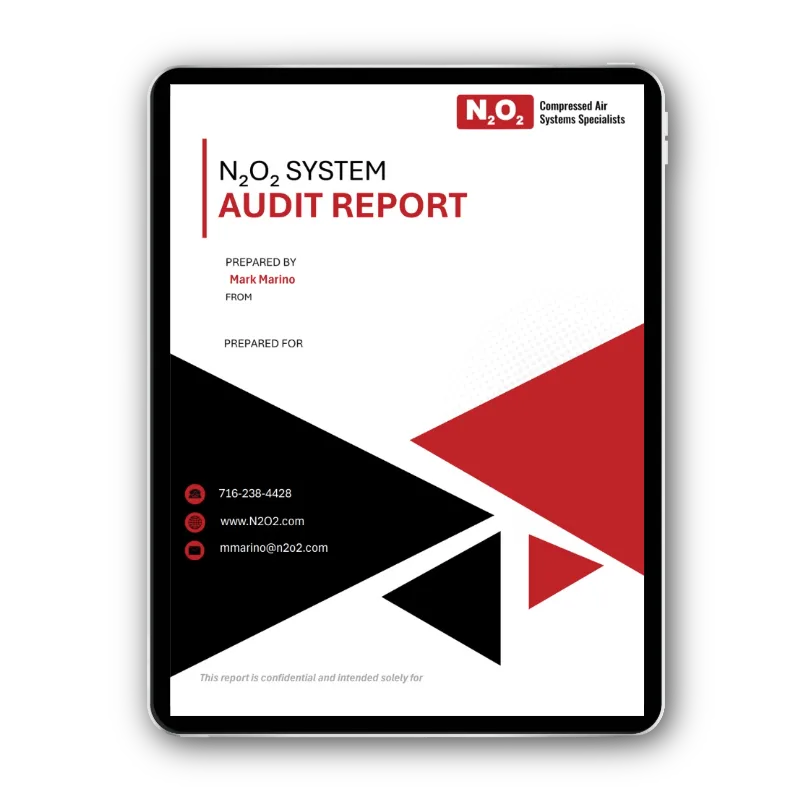
Your final report provides both technical findings and practical recommendations.
Depending on the audit scope, it may include:
- Executive summary and audit objectives
- Compressor efficiency compared with manufacturer specifications
- Pressure, power and demand data
- System-performance graphs and models
- Current operating costs
- Identified system losses and inefficiencies
- Recommended system improvements
- Recommendations prioritized by implementation timing
- Estimated equipment and installation costs
- Proposed operating costs
- Total estimated annual savings
- Updated compressor layout sketch
Recommendations are organized so your team can understand what should be addressed first, what can be planned for later and what level of investment may be required.
Understand How the Supply Side of Your Compressed Air System is Performing
Request a supply-side compressed air audit to evaluate compressor efficiency, controls, pressure, storage and operating costs under actual production conditions.
Supply Side Air Audit FAQs
No. Monitoring is completed while the facility continues normal production.
The audit measures compressor output, system demand, storage and pressure response. This data can help determine whether additional capacity is required or whether existing system conditions should be addressed first.
N2O2 typically requests compressor and dryer information, electrical cost, operating hours, number of shifts, a plant layout and a list of known system concerns.